A Cat Personality Portrait Example That Feels True
September 18, 2026
See a cat personality portrait example and learn how small details, favorite rituals, and quiet expressions become a lasting watercolor keepsake for years to come.
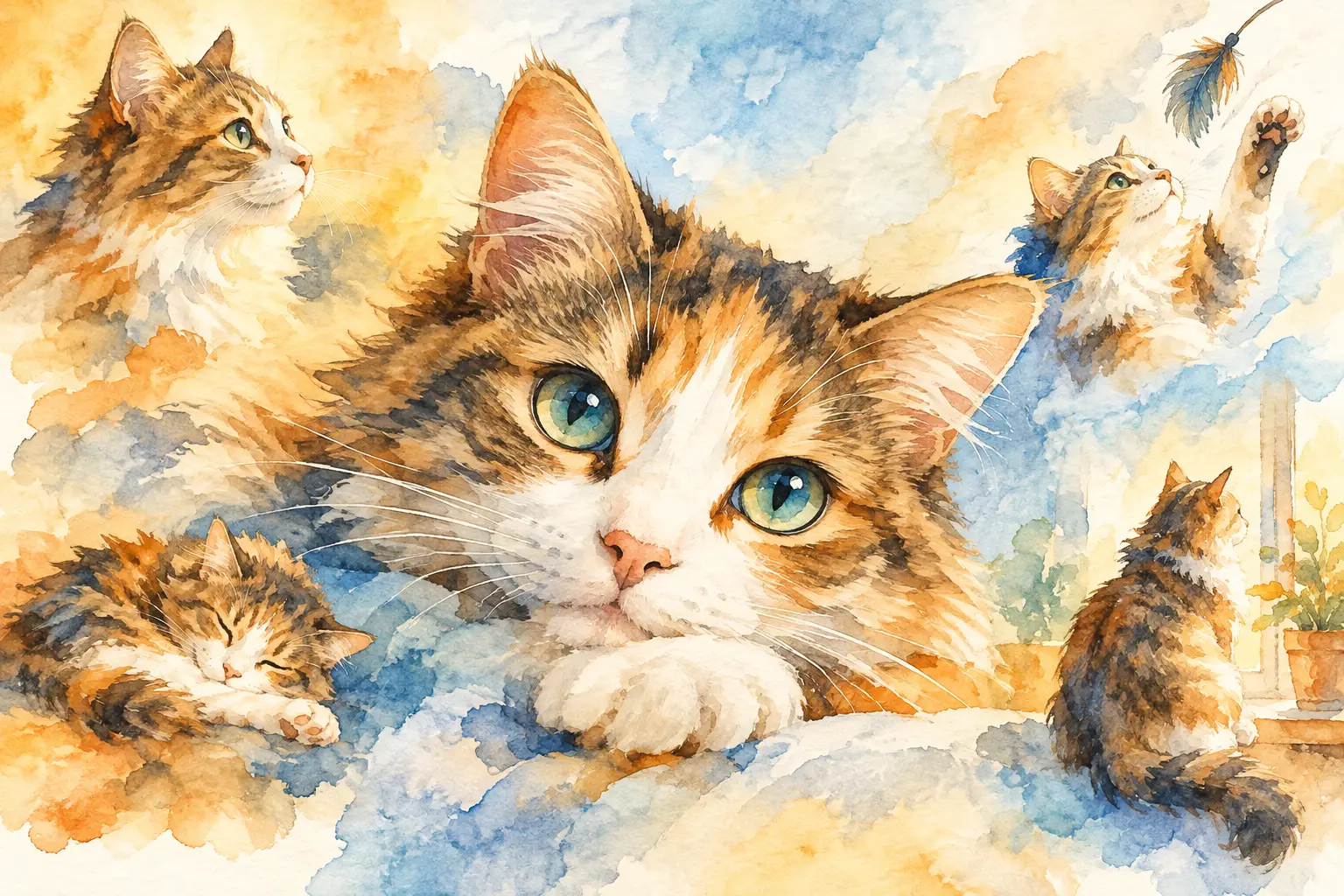
A meaningful cat personality portrait example does more than show a cat sitting beautifully in frame. It captures the familiar look that makes you smile before you can explain why: the slightly skeptical eyes, the tipped ear, the paw tucked neatly beneath the chest, or the regal pose your cat takes on the back of the sofa every afternoon.
For the person who loves them, these details are never small. They are the visual language of a relationship. A personal watercolor portrait gives that language a place to live - as a graceful celebration of a companion still curled up nearby, or as a tender remembrance of one who is deeply missed.
What a Cat Personality Portrait Can Look Like
Imagine a portrait of Luna, a silver tabby with wide green eyes and one tiny notch in her left ear. Her favorite place is the windowsill, where she watches birds with unwavering seriousness. Rather than presenting Luna as a generic tabby against an empty backdrop, her portrait holds the things that make her unmistakably Luna: the calm alertness in her gaze, the soft morning light around her, and the sense that she is quietly in charge of the room.
That is the difference between a likeness and a personality portrait. A likeness answers, “Does this look like my cat?” A personality portrait also answers, “Does this feel like my cat?”
The answer may be found in a grand detail, such as a magnificent Maine Coon ruff or a pair of bright amber eyes. More often, it lives in subtler choices. A shy rescue cat may be remembered with a softened expression and a peaceful, protected feeling. A spirited kitten may suit a brighter scene with a lifted chin and curious eyes. An elderly cat who spent years claiming one particular chair may be portrayed with the quiet dignity that made that chair theirs.
The Details That Make the Portrait Personal
Your cat does not need to be perfectly posed to inspire beautiful art. In fact, the most revealing photo is often one that reflects an everyday truth. A cat peering from beneath a blanket, sunbathing across a favorite rug, or sitting with an opinionated tilt of the head can offer more personality than a formal photograph ever could.
Begin with the features you notice first. Consider their eye color, markings, coat texture, and signature expressions. Then think beyond appearance. Is your cat affectionate only on their own schedule? Are they a fearless climber, a patient lap companion, a midnight zoomer, or a gentle observer who keeps watch from the highest shelf?
Those qualities help set the emotional direction of the portrait. A confident cat may call for a composed, stately presence. A playful cat may feel best represented with warmth and liveliness. For a memorial portrait, you may prefer an atmosphere that is peaceful and luminous rather than overtly sad. There is no single right approach. The right one is the one that feels honest to the life you shared.
A portrait example for a beloved memorial
Consider Oliver, a black-and-white tuxedo cat remembered for greeting everyone at the door. His person chooses a favorite photograph where his white whiskers stand out against his dark face, and shares that he was affectionate, curious, and never far from the family kitchen.
His finished portrait does not need a literal doorway or a bowl in the background to tell his story. The gentle warmth in his expression, the distinctive white bib, and the welcoming quality of the composition can carry that memory with restraint. It becomes a beautiful way to keep Oliver present without trying to replace him.
Memorial art can be especially meaningful when it preserves the version of a pet you want held close: bright-eyed, peaceful, dignified, and entirely themselves. It gives love somewhere tangible to rest.
A portrait example for a cat who is still with you
Now picture Pepper, a fluffy orange cat who sleeps in a patch of sunlight every day, then becomes wonderfully demanding at dinner. His person selects a photo that shows his soft, slightly rumpled coat and relaxed half-closed eyes. They describe him as affectionate, food-motivated, and convinced the household exists to serve him.
A watercolor portrait can honor both sides of Pepper: the softness of his resting pose and the unmistakable confidence behind it. Years from now, it will still recall not only his coloring and shape, but the feeling of sharing a home with him during this particular season of life.
How to Choose the Right Photo
A clear photo helps preserve your cat’s individual features, especially around the eyes, nose, whiskers, and markings. Natural light is often lovely because it reveals coat color without flattening it. Choose an image where the face is visible and the expression feels familiar.
Perfection is not the goal. A photo taken on a phone can be deeply suitable if it holds the right feeling. Sometimes the image with a little imperfect lighting is the one that shows the exact look you know best.
If you are deciding between several photographs, ask yourself a simpler question: which one would make you say, “There they are”? Trust that response. You know your cat better than anyone, and your recognition is the most valuable creative direction you can give.
Share the Story Behind the Face
The personal details you provide matter as much as the photo. A few thoughtful lines can transform the emotional center of a portrait. You might describe a beloved habit, a favorite sleeping place, the way your cat greeted you, or the quality you will always associate with them.
There is no need to write a perfect tribute. A sentence such as “She chirped at birds every morning,” “He always slept on my chest,” or “She was brave after a difficult beginning” can say a great deal. These observations help guide a portrait toward the truth of your bond.
This is especially helpful when your cat’s personality was wonderfully contradictory. Perhaps they were aloof with visitors but devoted to you. Perhaps they looked fierce but followed you from room to room. Those contrasts are not complications. They are often the details that make a portrait feel most alive.
Why Watercolor Suits a Cat’s Character
Watercolor has a softness that works beautifully with feline features, from the feathered edges of long fur to the delicate structure of whiskers and ears. It can feel refined without becoming stiff, and expressive without losing the details that make a cat recognizable.
The trade-off is intentional. If your only goal is a clinical, photo-for-photo copy, a watercolor style may feel gentler than expected. But if you want an artwork that preserves character, memory, and emotional presence, that softness is part of its strength. It leaves room for the feeling of your cat, not only the outline of them.
A museum-quality digital file also gives you the freedom to choose how the portrait lives in your home. You may print it in a size that suits a quiet bedside space, a family gallery wall, or a place near the chair your cat still considers their own. The portrait remains yours to keep in the way that feels right.
Create a Portrait That Feels Like Home
With Pet Legacy Portraits, you remain the creative force behind the finished piece. Your photograph, your memories, and your understanding of your cat shape the portrait’s heart. The guided process helps turn those personal details into a high-resolution watercolor artwork, prepared within five business days for you to print and cherish.
Whether you are celebrating a cat who still pads through the hallway or honoring one whose absence has changed the shape of home, choose the details that bring them closest. The knowing gaze. The crooked whisker. The place in the sun. These are the things love remembers, and they are more than enough to begin.